
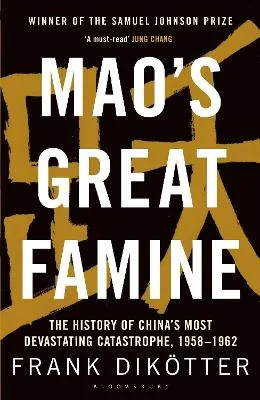
Description
By (author) Dikötter, Frank
Short /annotation:
An unprecedented, groundbreaking history of China”s Great Famine
Winner of the BBC Samuel Johnson Prize 2011
:
WINNER OF THE BAILLIE GIFFORD PRIZE
‘A gripping and masterful portrait of the brutal court of Mao, based on new research but also written with great narrative verve” Simon Sebag Montefiore
”Harrowing and brilliant” Ben Macintyre
‘A critical contribution to Chinese history” Wall Street JournalBetween 1958 and 1962, 45 million Chinese people were worked, starved or beaten to death. Mao Zedong threw his country into a frenzy with the Great Leap Forward, an attempt to catch up with and overtake the West in less than fifteen years. It led to one of the greatest catastrophes the world has ever known. Dikotter”s extraordinary research within Chinese archives brings together for the first time what happened in the corridors of power with the everyday experiences of ordinary people, giving voice to the dead and disenfranchised. This groundbreaking account definitively recasts the history of the People”s Republic of China.
Review quote:
”A masterpiece of historical investigation into one of the world”s greatest crimes”
Review quote:
‘It is hard to exaggerate the achievement of this book in proving that Mao caused the famine … only thanks to brilliant scholarship such as this will the heirs of the vanished millions finally learn what happened to their ancestors”
Review quote:
‘The most authoritative and comprehensive study of the biggest and most lethal famine in history. A must-read”
Review quote:
‘Gripping … Prof Dikötter”s painstaking analysis of the archives shows Mao”s regime resulted in the greatest “man-made famine” the world has ever seen”
Biographical note:
Frank Dikötter is Chair Professor of Humanities at the University of Hong Kong and Professor of the Modern History of China at the School of Oriental and African Studies, University of London. He is a key proponent of studying the history of China in global perspective, and has published a series of innovative books, from his classic The Discourse of Race in Modern China (Univ. Stanford Press 1992) to the controversial Narcotic Culture: A History of Drugs in China (Univ. Chicago Press 2004). He lives in Hong Kong.
Promotional headline:
A groundbreaking history of China”s Great FamineWinner of the BBC Samuel Johnson Prize 2011
Feature:
Groundbreaking:
Just as Iris Chang”s The Rape of Nanking rewrote history, so will Mao”s Great Famine. It will change the received understanding of the Mao era.
Feature:
Authoritative:
An acclaimed historian at the top of his craft, based on thousands of documents never before seen.
Feature:
Compelling:
Chronicles the vicious and dramatic behind-the-scenes battles that put Mao in power and kept him there. And, despite the tragedy in the countryside, the stories of everyday people are riveting.


Reviews
There are no reviews yet.