
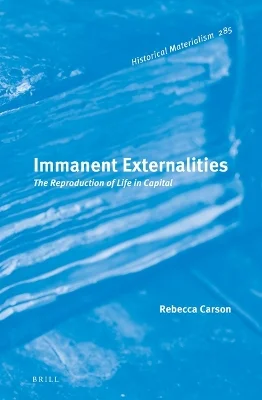
Description
By (author) Carson, Rebecca
Short /annotation:
This book philosophically reconstructs Marx’s Capital from the perspective of reproduction to produce an original reflection on the prospects for human life and nature’s survival within capitalism.
:
Environmental degradation, crises in care and the predations of finance capital impose new challenges to human reproduction. It is imperative to understand their roots in capitalism. But how best to do so? This book develops the concept of ‘immanent externalities’ to grasp the non-capitalist life processes produced by – and necessary for – capitalist reproduction. Immanent Externalities thus considers the category of reproduction by means of a philosophical re-reading of the three volumes of Marx’s Capital. In doing so, the book locates capitalism’s fundamental contradiction as that between the reproduction of profit-driven activity and ecologically situated human life, suggesting new orientations for theory and practice today.
Table of contents:
AcknowledgementsIntroduction1 Fictitious Capital and the Re-emergence of Personal Forms of Domination Introduction 1.1 Fictitious Capital 1.2 Fictitious Capital and Value Form 1.3 Social Reproduction and Personal Domination2 Money Form Introduction 2.1 Political Subjectivity and the Monetary Link between Italian Operaismo and Capital Logic 2.2 Money as Money3 Fetish Character Introduction 3.1 The Presupposition of Reification and The Money Form 3.2 Personal and Impersonal Forms of Domination4 Time and Schemas of Reproduction Introduction 4.1 The Circulation of Capital 4.2 Interruptions and Differential Temporal Forms within Capital’s Reproduction 4.3 Marx’s Presentation of The Metamorphoses of Capital and Their Circuit 4.4 Marx’s Presentation of The Turnover of Capital 4.5 Marx’s Presentation of the Reproduction and Circulation of Total Social Capital 4.6 The Three Circuits of Capital 4.7 The Role of the Credit System within Capital’s Reproduction 4.8 Expanded Reproduction 4.9 A Complete Concept of Money for Understanding Capital’s Reproduction 4.10 Non-capitalist Variables within Capital’s Reproduction Conclusion5 Marx’s Social Theory of Reproduction Introduction 5.1 Capital’s Life Process 5.2 Intersubjective Structures 5.3 The Category of Reproduction in Hegel’s The Science of Logic 5.4 Concrete Reproduction of Human Life and Nature 5.5 Marx’s Two Concepts of Life ConclusionBibliographyIndex
Review quote:
“Carson blazes a path with a crucial, rigorous analysis that combines social reproduction theory with the capital-logic approach, proving rather than showing the contradiction between capital and life.”——Marina Vishmidt, Goldsmiths, University of London“Carson”s work is an original, and scholarly, investigation of the relation between social reproduction and capital”s reproduction of itself.”——Christopher J. Arthur, author of The Spector of Capital“Carson combines erudition and insight, conceptual sophistication and bold engagement, to offer an understanding of the new capitalist logic where the violent clash of extremes : the “life” of financial accumulation and the “life” of bodily reproduction, is pushed to its limits. Her theory will be passionately discussed, for the greatest benefit of scholars and activists.”——Etienne Balibar, Kingston University, London
Biographical note:
Rebecca Carson, Ph.D. (2022), Kingston University, is a Tutor at the Royal College of Art. She has published widely on Marx and reproduction, including the articles “Fictitious Capital and the Re-emergence of Personal Forms of Domination” (Continental Thought and Theory, 2017) and “Non-capitalist Domination, Rentierism and the Politics of Class” (Crisis and Critique, 2023).



Reviews
There are no reviews yet.