
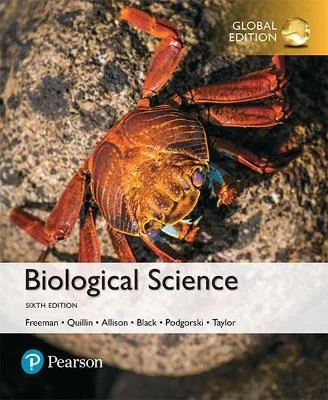
Description
By (author) Freeman Scott; By (author) Quillin Kim; By (author) Allison, Lizabeth; By (author) Black, Michael; By (author) Taylor, Emily; By (author) Podgorski Greg; By (author) Carmichael Jeff
For introductory courses for biology majors. Uniquely engages biology students in active learning, scientific thinking, and skill development. Scott Freeman’s Biological Science is beloved for its Socratic narrative style, its emphasis on experimental evidence, and its dedication to active learning. Science education research indicates that true mastery of content requires a move away from memorisation towards active engagement with the material in a focused, personal way. Biological Science is designed to equip students with strategies to assess their level of understanding and identify the types of cognitive skills that need improvement. With the 6th Edition, content has been streamlined with an emphasis on core concepts and core competencies from the Vision and Change in Undergraduate Biology Education report. The text’s unique BioSkills section is now placed after Chapter 1 to help students develop key skills needed to become a scientist, new “Making Models” boxes guide learners in interpreting and creating models, and new “Put It all Together” case studies conclude each chapter and help students see connections between chapter content and current, real-world research questions. New, engaging content includes updated coverage of global climate change, advances in genomic editing, and recent insights into the evolution of land plants.
Table of contents
1. Biology and the Tree of LifeBioSkillsI. THE MOLECULAR ORGIN AND EVOLUTION OF LIFE2. Water and Carbon: The Chemical Basis of Life3. Protein Structure and Function4. Nucleic Acids and the RNA World5. An Introduction to Carbohydrates6. Lipids, Membranes, and the First CellsII. CELL STRUCTURE AND FUNCTION7. Inside the Cell8. Energy and Enzymes: An Introduction to Metabolism9. Cellular Respiration and Fermentation10. Photosynthesis11. Cell-Cell Interactions12. The Cell CycleIII. GENE STRUCTURE AND EXPRESSION13. Meiosis14. Mendel and the Gene15. DNA and the Gene: Synthesis and Repair16. How Genes Work17. Transcription, RNA Processing, and Translation18. Control of Gene Expression in Bacteria19. Control of Gene Expression in Eukaryotes20. The Molecular Revolution: Biotechnology and Beyond21. gGenes, Development, and EvolutionIV. EVOLUTIONARY PATTERNS AND PROCESSES22. Evolution by Natural Selection23. Evolutionary Processes24. Speciation25. Phylogenies and the History of LifeV. THE DIVERSIFICATION OF LIFE26. Bacteria and Archaea27. Protists28. Green Algae and Land Plants29. Fungi30. An Introduction to Animals31. Protostome Animals32. Deuterostome Animals33. VirusesVI. HOW PLANTS WORK34. Plant Form and Function35. Water and Sugar Transport in Plants36. Plant Nutrition37. Plant Sensory Systems, Signals, and Responses38. Plant Reproduction and DevelopmentVII. HOW ANIMALS WORK39. Animal Form and Function40. Water and Electrolyte Balance in Animals41. Animal Nutrition42. Gas Exchange and Circulation43. Animal Nervous Systems44. Animal Sensory Systems45 Animal Movement46. Chemical Signals in Animals47. Animal Reproduction and Development48. The Immune System in AnimalsVIII. ECOLOGY49. An Introduction to Ecology50. Behavioral Ecology51. Population Ecology52. Community Ecology53. Ecosystems and Global Ecology54. Biodiversity and Conservation Biology
Feature
Develop skills-based learning in biology: Building on the extensive skills instruction in previous editions, the 6th Edition places an even greater emphasis on developing important science skills that reinforce concepts in biology.


Reviews
There are no reviews yet.