
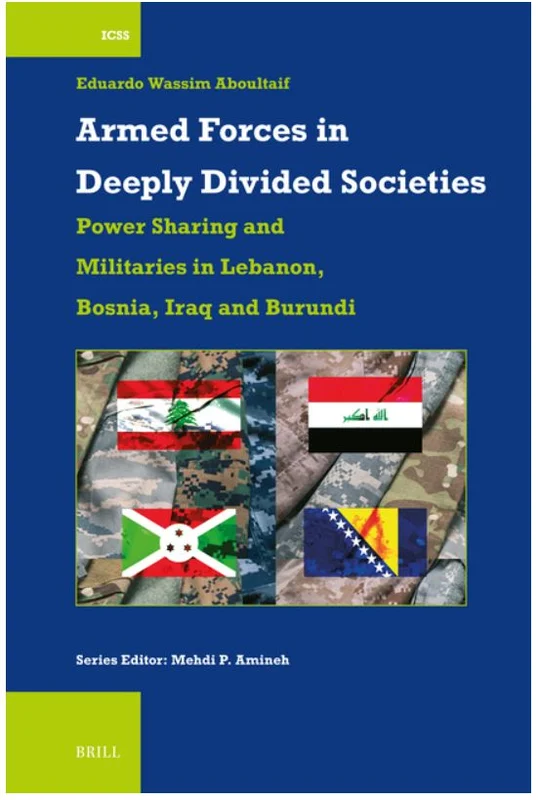
Description
By (author) Aboultaif, Eduardo Wassim
Short /annotation:
Eduardo Wassim Aboultaif explains the control, function and construction of armies in divided societies with power-sharing arrangements. The book is based on a thorough analysis of four case studies characterized by power-sharing and post-conflict environment: Lebanon, Bosnia-Herzegovina, Iraq and Burundi.
:
Eduardo Wassim Aboultaif critically analyzes civil–military relations and the way armies are constructed in divided societies. To achieve that, the book looks at four case studies with deep divisions and whose armed forces have been reconstructed after civil wars. Lebanon and Bosnia-Herzegovina represent two examples of consociational power-sharing arrangements with functioning armed forces that enjoy wide popular support and neutral in internal affairs. Iraq and Burundi, however, have semi-consociational provisions that have politicized the army and made it a partisan military that has either led to disintegration (as in the case of Iraq) or politicization and loss of legitimacy (as in Burundi).
Table of contents:
AcknowledgementsList of Figures and Tables1 Introduction 1 A Critical Approach to Armies in Divided Societies 2 Framework and Aim of the Book 3 The Significance of Armies in Divided Societies and Research Method 4 Chapters2 Civil-Military Relations, SSR, DDR, and Power Sharing 1 Civil-Military Relations 2 DDR and Security Sector Reform (SSR) 3 Post-Conflict Power Sharing and Security Apparatuses 4 Conclusion3 The Lebanese Armed Forces 1 Origins: The LAF during the Mandate Period 2 The Army after Independence 2.1 The Formation of the Lebanese Army 2.2 Problems and Challenges 3 Paying the Price: Disintegration during the Civil War 4 Structural and Institutional Reforms of the Lebanese Armed Forces (LAF) 4.1 Structural Reforms in the LAF 4.2 The Institutional Reforms 4.2.1 The Higher Defense Council 4.2.2 The Military Office 5 Reconstructing the LAF 6 Challenges and Responses 6.1 Military Capabilities 6.2 Legitimacy and National Consensus 6.3 Confessional-Proofing in the LAF – Preserving Neutrality 6.4 Gender and Human Rights 7 Conclusion4 Armed Forces of Bosnia and Herzegovina 1 The Yugoslav People’s Army (Jugoslovenska Narodna Armija, JNA) 2 The Making of the AFBiH 3 Institutional and Structural Reforms in the AFBiH 3.1 Institutional Reforms 3.2 Structural Reforms 4 Success and Setbacks 5 Conclusion5 The Iraqi Armed Forces 1 Inception: The Establishment of the Iraqi Army 2 Bakr Sidqi and the Rise of as-Sabbagh 3 The Republic of Abdul-Karim Qassim 4 The Rise of the Baath and the Baathification of the Army 5 The Army and the Baath 6 Reconstructing the IAF after the 2003 Invasion 6.1 CPA Civil-Military Decisions 7 The Reconstruction Framework of the Iraqi Army 7.1 The New IAF 8 Problems and Challenges in the IAF 8.1 Professionalism 8.2 Civil-Military Ambiguity 8.3 Corruption 9 ISIS, the PMF and the Retraining of the Iraqi Military 10 Conclusion6 The National Defense Force of Burundi 1 Burundi: The Colonial Period and Independence 2 The Army in Power 2.1 Micombero 2.2 Bagaza 2.3 Buyoya 3 The Hutu Response 4 Arusha and Pretoria 5 Institutional and Structural Changes in the Armed Forces 5.1 Institutional Reforms 5.2 Structural Reforms 6 From Success to Failure: CNDD-FDD Hegemony in Security Affairs 7 CNDD-FDD Hegemony in the Army 7.1 FDD Preferentialism and Elimination of Opponents 7.2 Alternative Chain of Command and the Imbonerakure 7.3 The National Intelligence Service (SNR) and the CNDD-FDD 8 The Dangers of CNDD-FDD Politicization of the Army 9 Conclusion7 Armies in Consociational, Semi-Consociational, and Post-Conflict Societies: The Quest for Stability 1 Armies, Deeply Divided Societies and Non-Democrati



Reviews
There are no reviews yet.