
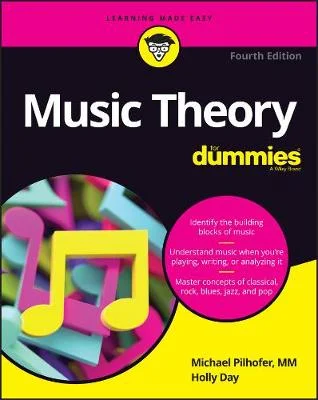
Description
By (author) Pilhofer, Michael – Day, Holly; By (author) Pilhofer, M
Tune in to how music really works
Whether you’re a student, a performer, or simply a fan, this book makes music theory easy, providing you with a friendly guide to the concepts, artistry, and technical mastery that underlie the production of great music. You’ll quickly become fluent in the fundamentals of knocking out beats, reading scores, and anticipating where a piece should go, giving you a deeper perspective on the works of others — and bringing an extra dimension to your own.
Tracking to a typical college-level course, Music Theory For Dummies breaks difficult concepts down to manageable chunks and takes into account every aspect of musical production and appreciation — from the fundamentals of notes and scales to the complexities of expression and instrument tone color. It also examines the latest teaching techniques — all the more important as the study of music, now shown to provide cognitive and learning benefits for both children and adults, becomes more prevalent at all levels.
- Master major and minor scales, intervals, pitches, and clefs
- Understand basic notation, time signals, tempo, dynamics, and navigation
- Employ melodies, chords, progressions, and phrases to form music
- Compose harmonies and accompanying melodies for voice and instruments
Wherever you want to go musically — as a writer or performer, or just as someone who wants to enjoy music to its fullest — this approachable guide gives you everything you need to hear!
Table of contents
Introduction
1
About This Book 1
Foolish Assumptions 2
Icons Used in This Book 3
Beyond the Book 3
Where to Go from Here 3
Part 1: Getting Started with Music Theory 5
Chapter 1: What Is Music Theory, Anyway?
7
Unearthing Music Theory’s Beginnings 8
Putting the Spotlight on Music Theory Fundamentals 9
Understanding the foundation: Notes, rests, and beats 9
Manipulating and combining notes 9
Studying musical form and compositions 11
Seeing How Theory Can Help Your Music 11
Chapter 2: Determining What Notes Are Worth
13
Meeting the Beat 14
Recognizing Notes and Note Values 15
Examining the notes and their components 15
Looking at note values 17
Checking Out Whole (Semibreve) Notes 18
Homing in on Half (Minim) Notes 19
Considering Quarter (Crotchet) Notes 20
Examining Eighth (Quaver) Notes and Beyond 20
Extending Notes with Dots and Ties 22
Using dots to increase a note’s value 22
Adding notes together with ties 23
Mixing All the Note Values Together 23
Chapter 3: Giving It a Rest
27
Getting to Know the Rests 28
Whole (semibreve) rests 28
Half (minim) rests 29
Quarter (crotchet) rests 30
Eighth (quaver) rests and beyond 30
Extending the Break with Dotted Rests 32
Practicing Beats with Notes and Rests 32
Chapter 4: Introducing Time Signatures
35
Decoding Time Signatures and Measures 35
Keeping Things Easy with Simple Time Signatures 37
Using measures to count in simple time 38
Practicing counting beats in simple time 40
Working with Compound Time Signatures 41
Using measures to count in compound time 42
Practicing counting beats in compound time 43
Feeling the Pulse of Asymmetrical Time Signatures 44
A Short Discussion about Conducting 46
The beat 47
Phrasing, articulation, and dynamics 49
Cueing 49
Chapter 5: Playing with Beat
51
Creating Stress Patterns and Syncopation 51
Placing stress: Knowing the general rules 52
Syncopation: Hitting the off




Reviews
There are no reviews yet.