
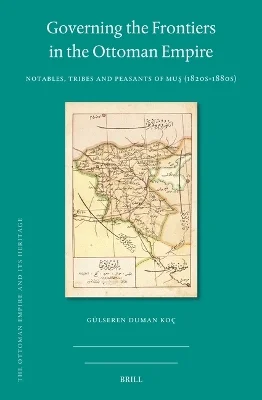
Description
By (author) Duman Koç, Gülseren
Short /annotation:
The book presents a snapshot of a locality in a multi-ethnic, multi-religious region in the Ottoman East in the nineteenth century.
:
Based on many previously unused sources from Ottoman and British archives, Governing the Frontiers in the Ottoman Empire offers a micro-history to understand the nineteenth century Ottoman reforms on the eastern frontiers. By examining the administrative, military and fiscal transformation of Muş, a multi-ethnic, multi-religious sub-province in the Ottoman East, it shows how the reforms were not top-down and were shaped according to local particularities. The book also provides a story of the notables, tribes and peasants of a frontier region. Focusing on the relations between state-notables, notables-tribes, notables-peasants and finally tribes-peasants, the book shows both the causes of contention and collaborations between the parties.
Table of contents:
AcknowledgementsList of IllustrationsA Note on Transliteration1 Introduction 1.1 Frontiers, Tanzimat and Provincial Studies 1.2 Historical Geography of Muş 1.3 About the Sources 1.4 Structure of the Book2 Emin Pasha of Muş: A Negotiation of Power in the Periphery of the Ottoman Empire 2.1 Notables of Muş and the Nature of Their Political and Economic Power 2.2 The Rise of Emin Pasha 2.3 Utilization of Frontier Tribes 2.4 Conclusion3 The Revolt of Emin Pasha: Punishment and Cooptation 3.1 Preparation for the Revolt: In the Pursuit of Allies 3.2 Between Negotiation and Contest 3.3 The Contours of Negotiation 3.4 The Reappointment of Emin Pasha 3.5 Muş in the Course of Centralization Efforts: The First Phase of the Abolition of Yurtluk-Ocaklıks 3.6 Conclusion4 The Tanzimat State in Muş: Collaboration with and Punishment of Local Actors 4.1 On the Eve of the Application of Tanzimat Reforms: A Network of Exploitation 4.2 The Tanzimat State in Muş 4.3 Old Actors and the New Regime 4.4 Şerif Bey as Mediator: The Beginning of the End 4.5 Exile of Alaaddin Pashazades from Muş 4.6 Conclusion5 Aftermath of the Exile of the Yurtluk-Ocaklık Holders 5.1 Confiscation of the Yurtluk-Ocaklık Villages of Şerif Bey and His Brothers and Its Implications 5.2 Limits of the Villages and the Determination of Salaries 5.3 Struggle for Forgiveness 5.4 Debate over the Yurtluk-Ocaklık Villages of Emin Pasha 5.5 Future of the Yurtluk-Ocaklık Salaries 5.6 Conclusion6 The Post Tanzimat Era: Evaluation of the Reforms through the Petitions of Ordinary People 6.1 Conflicting Viewpoints Regarding Governors 6.2 New Administrators, Old Habits 6.3 Socio-Economic Results of the Crimean War for Muş’s Locality 6.4 Council Members, Tax Farmers, Moneylenders and Peasants 6.5 Conclusion7 Governors, Tribes, and Peasants 7.1 Implications of the Tanzimat Reforms for the Nomadic Groups 7.2 Peasants and the Nomads: Settlement of the Tribes 7.3 Nomadic Tribes in the Vicinity of the Sanjak of Muş8 The Hesenan Tribe: The Cases of Rıdvan and Kulihan Aghas 8.1 The Tribes in Dispute: Conflicts between the Tribes of Muş and Those of Its Vicinity 8.2 In Lieu of a Conclusion9 ConclusionBibliographyIndex
Biographical note:
Gülseren Duman Koç, Ph.D. (2018), Boğaziçi University, is an assistant professor of History at Istanbul Medeniyet University, Turkey. She has published articles and book chapters in English and Turkish.



Reviews
There are no reviews yet.