
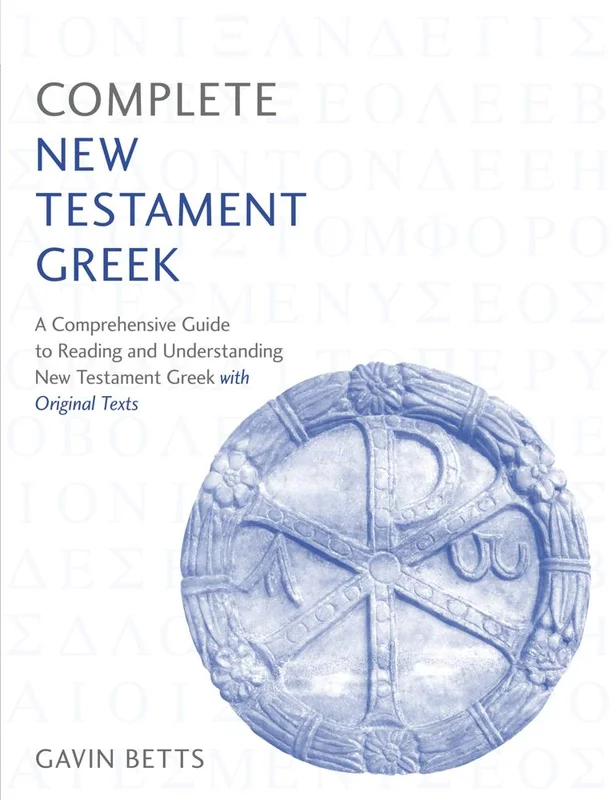
Description
By (author) Betts Gavin
Short /annotation:
Carefully structured units teach Greek from the New Testament right from the start, and topics of interest for New Testament studies are introduced as appropriate. This new edition makes learning fast and hassle-free, with an easy-to-read page design and extra exercises provided online.
:
Designed for complete beginners, and tested for years with real learners,
Complete New Testament Greek offers a bridge from the textbook to the real world, enabling you to learn the grammar, understand the vocabulary and ultimately how to translate the language in which the Bible was originally written.
Structured around authentic material, placing an emphasis on the importance of reading Biblical texts in the original, and introducing both a grammar perspective and a full introduction to essential vocabulary, this course also features:
-21 learning units plus maps and verb guide
-Authentic materials – language taught through key texts
-Teaches the key skills – reading and understanding Greek grammar and vocabulary
-Self tests and learning activities – see and track your own progress
Rely on Teach Yourself, trusted by language learners for over 75 years.
Table of contents:
- : Introduction
- : How to use this book
- : Glossary of grammatical terms
- : Abbreviations
-
- : Unit 1: 1.1/1 The Greek alphabet and its pronunciation /2 Accents .2 Exercise
- : Unit 2: 2.1/1 Nouns in Greek /2 Second declension and the masculine and neuter definite article /3 Basic uses of cases /4 Verbs in Greek /5 Present and future indicative active /6 Word order and elision .2 Greek reading /1 Vocabulary .3 The nature o
- : Unit 3: 3.1/1 First declension (feminine nouns) and the feminine definite article /2 First declension (masculine nouns) /3 First and second declension adjectives /4 Adverbs /5 Prepositions /6 Present indicative and infinitive of ”I am” .2 Greek read
- : Unit 4: 4.1/1 Imperfect indicative active and weak aorist indicative and infinitive active /2 Personal pronouns /3 Non-Greek proper nouns /4 Connecting particles .2 Greek reading /1 Vocabulary .3 Excursus—Books in antiquity
- : Unit 5: 5.1/l Third declension—consonant stem nouns (1) /2 Contracted verbs /3 Further uses of the definite article .2 Greek reading /1 Vocabulary
- : Unit 6: 6.1/1 Third declension—consonant stem nouns (2) /2 ”know” /3 Compound verbs formed with prepositional prefixes /4 stems in palatals, labials, dentals .2 Greek reading /1 Vocabulary
- : Unit 7: 7.1/1 Strong aorist indicative and infinitive active /2 Direct and indirect speech /3 ”say” and direct speech /4 Indirect command /5 Numerals /6 Phrases expressing time and space .2 Greek reading /1 Vocabulary
- : Unit 8: 8.1/1 Middle and passive voices /2 Deponent verbs /3 Negatives /4 Indirect statement /5 Third declension nouns—stems .2 Greek reading /1 Vocabulary .3 Excursus—How the New Testament has been transmitted
- : Unit 9: 9.1/1 Demonstrative pronouns /2 A relative pronoun and adjectival clauses /3 Reflexive and reciprocal pronouns /4 Possessive adjectives and pronouns .2 Greek reading /1 Vocabulary
- : Unit 10: 10.1/1 Questions, direct and indirect /2 First and third declension adjectives /3 Third declension adjectives .2 Greek reading
- : Unit 11: 11.1/1 Aorist passive, root aorist and future passive /2 Agent and instrument /3 Crasis .2 Greek reading
- : Unit 12: 12.1/1 Participles /2 Uses of participles .2 Greek reading .3 Excursus—The text of the New Testament
- : Unit 13: 13.1/1 Moods of the Greek verb /2 Subjunctive mood /3 Uses of the subjunctive (1) /3 Optative mood and its uses .2 Greek reading
- : Unit 14: 14.1/1 Uses of the subjunctive (2) /2 Perfect indicative active .2 Greek reading



Reviews
There are no reviews yet.